
An OSP enclosure is a sealed housing that protects fiber splices and connections from weather, dirt, and physical damage when cable runs outside a building. OSP stands for “outside plant,” basically anything happening outdoors instead of inside a data center or telecom closet.
If you’re running fiber down a utility pole, across a right-of-way, or into a pedestal at the curb, you need one of these. Skip it, or buy the wrong one, and you’re looking at moisture intrusion, signal loss, or a truck roll six months from now to fix what should’ve been done right the first time.
That risk isn’t theoretical. The fiber industry just had its biggest buildout year ever, with close to 12 million new U.S. homes getting fiber access in 2025 alone. Every one of those new connections has outdoor splice points sitting in the field right now, exposed to heat, cold, and moisture. The OSP enclosure on each one is doing the real work of keeping that connection alive.
This isn’t a “nice to have.” It’s the difference between a network that holds up for fifteen years and one that’s calling for service techs every storm season.
Let’s get into where these get used, what ratings actually matter, and how to avoid the mistakes that cost real money down the line.
Where OSP Enclosures Get Used
You’re not putting one of these in a server room. They live outside, taking a beating, and they need to handle it.
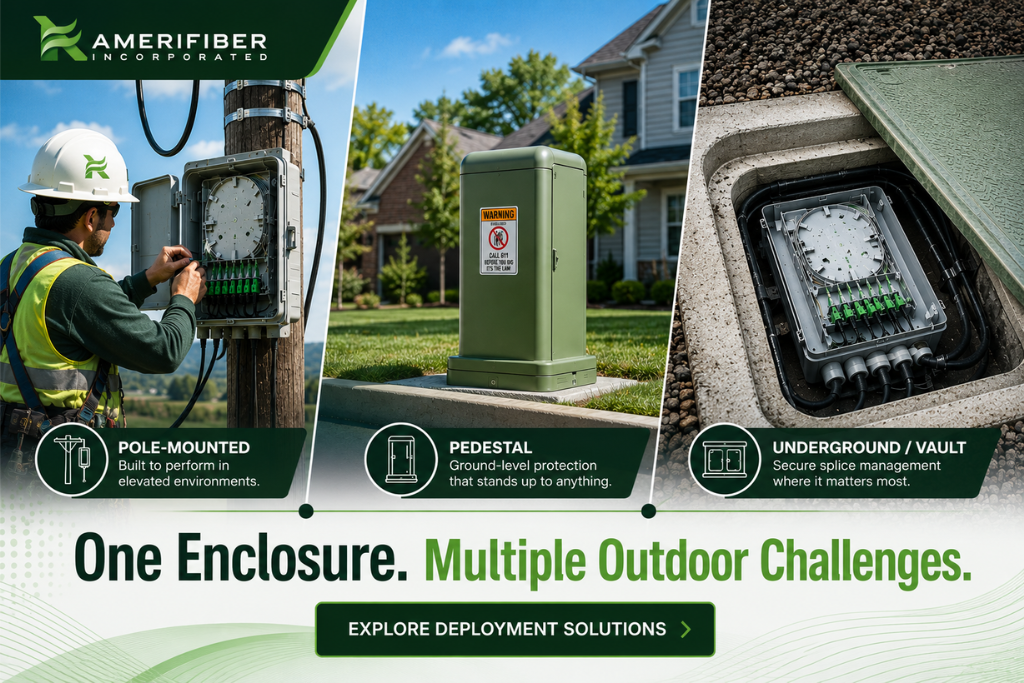
- Pole-mounted enclosures – hang off utility poles, hold the splice tray, shield everything from wind and rain. Common in rural co-op territory and smaller ISP last-mile builds.
- Pedestal enclosures – those green or gray boxes at the curb in newer subdivisions. They take constant abuse from lawnmowers, snowplows, and foot traffic, so the housing has to hold up without compromising the seal.
- Handhole and aerial closures – underground vaults for dense urban builds, or strand-mounted closures for mid-span splices on long-haul aerial runs. Different stress (water table and vibration vs. wind and UV), same need for a tight build.
Why location changes the spec
A Phoenix deployment and a Minneapolis deployment aren’t buying the same enclosure, even with identical splice counts. Heat and UV in the Southwest. Freeze-thaw cycling in the Midwest and Northeast. Salt air if you’re near the coast.
Contractors in a hurry grab whatever worked on the last job, regardless of region, then wonder why gaskets fail two years later. Match the enclosure to the environment, every time.
The Ratings That Actually Matter (IP65 and NEMA 4)
Specs on a data sheet mean nothing if you don’t know what they translate to in the field. Here’s the plain-English version.
IP65
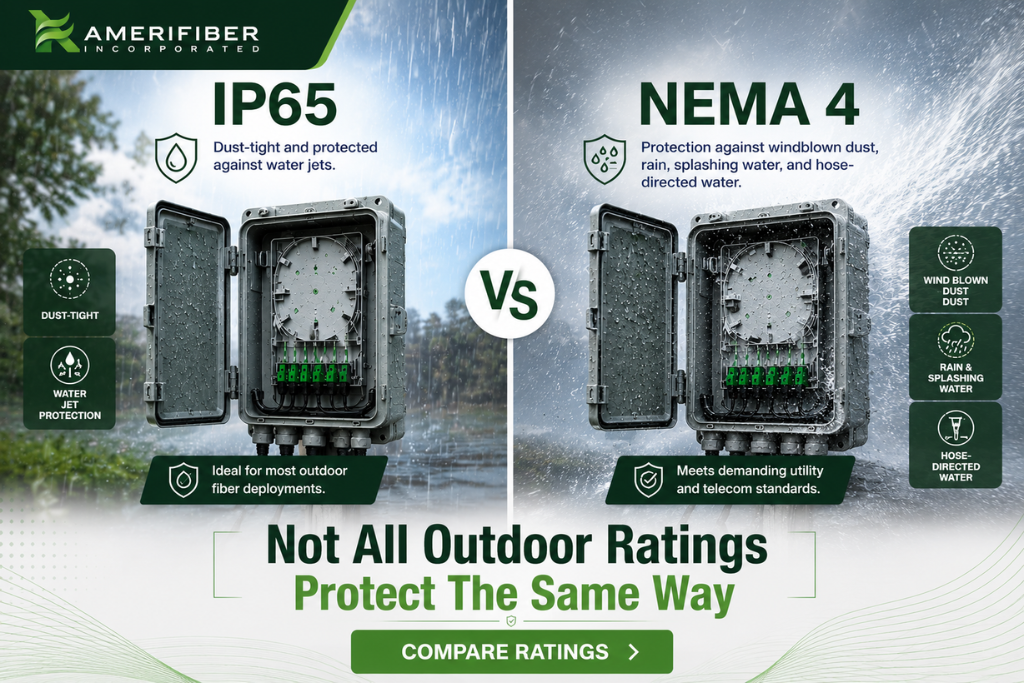
The “IP” stands for Ingress Protection. The first digit covers dust, the second covers water. IP65 means the enclosure is fully dust-tight and protected against water jets from any direction, like a heavy rainstorm or someone hosing down equipment nearby.
This is the standard rating for most pole-mounted and pedestal OSP enclosures, and it covers the vast majority of outdoor U.S. deployments just fine. Rain, snowmelt, road spray, dust from construction nearby. Amerifiber’s IP65 Rated Outdoor Fiber Enclosures handle all of it.
NEMA 4
NEMA ratings come from the National Electrical Manufacturers Association, and they’re the standard most U.S. utility and telecom contracts actually reference in their specs. NEMA 4 means protection against windblown dust, rain, splashing water, and hose-directed water. It’s roughly comparable to IP65/IP66 in practical terms, but if your contract or RFP specifically calls for NEMA ratings, that’s what you need on the spec sheet, not just an IP number.
This matters more than people think. A lot of utility co-ops and municipal contracts have NEMA requirements baked into procurement language. Hand them an enclosure that’s only IP-rated, even if it’s functionally equivalent, and you can get flagged in a compliance review. If your spec calls for it, Amerifiber’s NEMA 4 Rated Outdoor Fiber Enclosures are built to meet that requirement directly.
Where people get this wrong
The most common mistake: buying based on price and assuming “outdoor rated” is one universal standard. It’s not.
- A vented enclosure rated for basic weather resistance is not the same as a sealed IP65 unit.
- An enclosure that’s IP65 but not built for UV exposure will degrade fast in direct Southwest sun, even though the rating technically holds up against rain and dust.
- “Water resistant” on a cheap listing is marketing language, not a certification. If there’s no actual IP or NEMA number attached, don’t trust it.
Always check the actual outdoor fiber enclosure spec sheet, not just the product title. A real rating is tested and documented. A vague claim is a guess.
Bottom line
Match the rating to your deployment environment, and match it to whatever procurement language your contract requires. Guess wrong here and you’re not just risking enclosure failure. You’re risking a rejected install on a municipal or utility job.
Rookie Mistakes That Cost Money Later
Most enclosure failures aren’t bad luck. They’re bad decisions made at purchase time. Here’s what keeps showing up in the field.
Buying the exact port count you need today
Networks grow. If you buy an enclosure sized for today’s splice count with zero headroom, you’re looking at a full swap-out the next time you need to add capacity. That’s a truck roll, a service interruption, and labor cost that didn’t need to exist.
Buy with growth room. Always.
Ignoring temperature swings
A contractor in Texas and a contractor in Minnesota are dealing with completely different thermal stress on the same enclosure model. Repeated expansion and contraction from freeze-thaw cycles or extreme heat wears down seals and gaskets faster than people expect.
If your region swings more than 60-70 degrees seasonally, that’s a real factor in material selection, not a minor detail.
Skipping strain relief
Cable strain relief keeps the fiber from getting yanked, bent, or stressed at the point where it enters the enclosure. Skip it, or install it wrong, and you get microbends in the fiber that cause signal loss. Sometimes it shows up immediately. Sometimes it takes six months of wind and vibration before the line starts acting up.
This is a five-minute install step that gets rushed constantly.
Cheap gaskets failing in year two
This is the big one. A lot of low-cost OSP enclosures look identical to quality units on a spec sheet. Same dimensions, same port count, same IP rating on paper. The difference shows up in the gasket material.
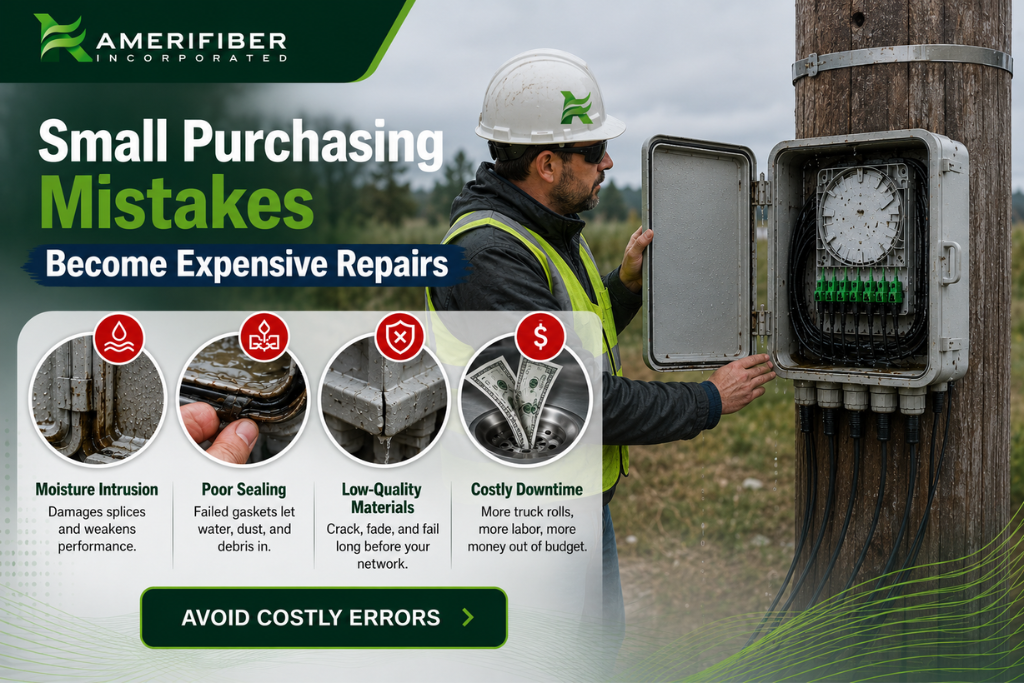
Cheap rubber compounds degrade under UV and temperature cycling faster than quality silicone or EPDM gaskets. The enclosure passes inspection on day one. Two years later, the seal is brittle, cracked, and letting moisture in. By the time anyone notices, you’ve already got corrosion or signal degradation on your hands.
Wrong mounting hardware for the job
Pole-mount hardware, pedestal mounting, and wall-mount brackets aren’t interchangeable. Crews in a hurry sometimes force a fit instead of ordering the right hardware. That creates stress points and gaps that compromise the whole seal, even on a good enclosure.
The pattern here
Every one of these mistakes saves a few minutes or a few dollars upfront. Every one of them costs more, in labor, downtime, or a full enclosure replacement, somewhere down the line.
Buy right the first time. It’s cheaper.
What to Check Before You Buy
Skip the marketing copy. Here’s what actually matters when picking an OSP enclosure.
- Port count headroom – buy for where the network’s headed in two to three years, not just today’s splice count.
- Splice tray capacity – check tray count and splices-per-tray, not just port count. They’re not always the same number.
- Mounting style compatibility – confirm pole, pedestal, wall, or vault mount before it ships. Field retrofits waste a trip.
- Connector type support – confirm the adapter plates support your actual standard (SC, LC, UPC, APC) before ordering.
- Material – UV-stabilized polycarbonate works for most pole and pedestal builds. Stainless costs more but holds up better in harsh coastal or industrial settings.
- Warranty terms – vague or short warranty language is a signal worth checking before a bulk order.
- Quote-based buying – specs vary by project and region. Amerifiber runs its OSP enclosure line on quotes for that reason; custom configurations are common because no two deployments match exactly.
Built in the USA vs. Imported, Does It Matter?
Short answer: yes, and not just for patriotic reasons.
Lead times
Imported enclosures often mean longer shipping windows, customs delays, and less flexibility if your project timeline shifts. A domestic manufacturer building a fiber optic enclosure outdoor unit stateside can usually turn around stock orders faster and adjust custom builds without waiting on overseas freight.
For ISPs and contractors working against BEAD funding deadlines or utility contract timelines, that lead time difference is real money, not a nice-to-have.
Quality consistency
Overseas suppliers vary wildly in quality control. You might get a great batch, then a mediocre one six months later from the same listing, with no easy way to verify what changed. Domestic manufacturers building to consistent specs, with a track record you can actually check, reduce that risk.
Amerifiber has been building fiber connectivity hardware in the U.S. for around three decades. That’s not a marketing line, it’s the kind of track record that matters when you’re specifying hardware for a network that needs to last fifteen-plus years in the field.
Custom-build turnaround
This is where domestic manufacturing really separates itself. Need a non-standard port configuration, a specific connector layout, or a custom enclosure size for a unique deployment? A U.S.-based manufacturer with in-house engineering can usually turn that around in weeks. Overseas custom orders often mean months, plus the back-and-forth of specs getting lost in translation, literally and figuratively.
The real takeaway
“Made in USA” isn’t just a sticker. For OSP hardware specifically, it usually translates to faster lead times, easier communication when something needs adjusting, and a manufacturer that’s actually accountable if a batch has issues.
That doesn’t mean every imported product is junk. It means domestic manufacturing removes a layer of risk and delay that a lot of contractors don’t think about until a project’s already behind schedule.
Bottom Line
An OSP enclosure isn’t a part you grab off a shelf and forget about. It’s the thing standing between your fiber network and fifteen years of weather, vibration, and abuse. Get the rating right, get the sizing right, skip the cheap gaskets, and you won’t be back out in the field fixing what should’ve been done right the first time.
If you’re specifying enclosures for a build right now and want to talk specs instead of guessing, call Amerifiber at 866-518-5858. They’ll walk through your port count, rating needs, and mounting setup, and get you a real quote built around your actual deployment, not a generic listing.