
As fiber networks continue to expand across residential, commercial, and industrial applications, efficient signal distribution becomes essential. That’s where PLC splitters come in. These compact passive components help service providers and network engineers distribute a single optical signal across multiple outputs without the need for power or complex configurations.
If you’re building or upgrading a fiber network and wondering what a PLC splitter is and how it fits into your deployment, this guide breaks it down clearly. We’ll cover how PLC splitters work, where they’re used, how to choose the right split ratio, and what to consider when sourcing quality fiber components.
Whether you’re planning an FTTx buildout, expanding a PON network, or setting up an enterprise fiber system, having a trusted partner matters. Companies like Amerifiber not only supply reliable PLC splitters and fiber solutions but also provide guidance for teams that may not have in-house fiber expertise.
What is a PLC Splitter?
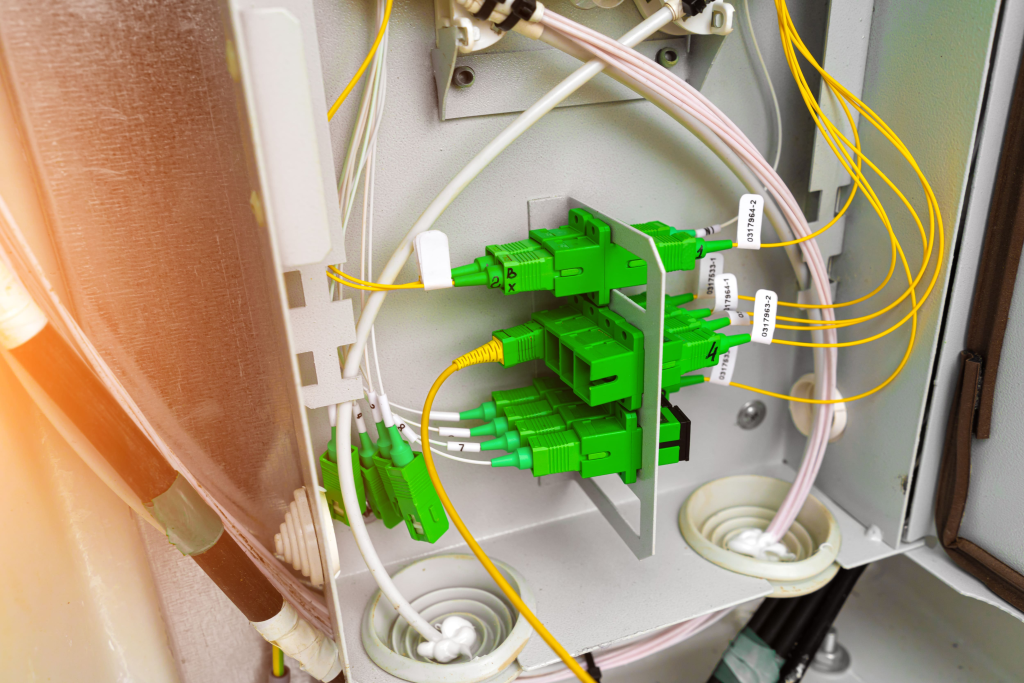
A PLC splitter (Planar Lightwave Circuit splitter) is a passive fiber optic device used to divide a single optical signal into multiple, equal output signals. It is one of the core components in Passive Optical Networks (PON) and is widely used in FTTx deployments, where a single fiber connection from the provider must be distributed to multiple subscribers.
Unlike electrical splitters, PLC splitters manage light transmission within fiber optic cables. They are built using silica optical waveguide technology on a semiconductor chip, which ensures precise and stable light distribution. This design makes PLC splitters ideal for networks that require consistent performance across multiple outputs.
In simple terms: A PLC splitter allows you to share one fiber input with multiple endpoints without losing signal quality across the network.
They are available in different split configurations, such as 1×2, 1×4, 1×8, 1×16, 1×32, and 1×64, depending on how many connections are needed. These split ratios help optimize network efficiency while controlling installation costs.
How Does a PLC Splitter Work?
To understand how a PLC splitter works, imagine shining a flashlight through a piece of glass that divides the beam evenly in different directions. A PLC splitter does something similar—but with laser light signals inside a fiber optic network.
Inside every PLC splitter is a small chip made using planar lightwave circuit technology. This chip takes in one optical input and carefully divides the light signal into multiple outputs. Because the internal pathways are made with precision, each output carries an equal share of the signal, making PLC splitters ideal for balanced network distribution.
For example, a 1×4 PLC splitter takes one fiber input and splits it evenly into four outputs. Each output receives about 25% of the original signal power. This slight reduction in power is called insertion loss, and it’s a normal part of any fiber-splitting process. What matters is keeping that loss consistent—and PLC technology does exactly that.
In real networks, PLC splitters are used to send a fiber connection from a central office or distribution hub to multiple homes, offices, or network devices. Since they don’t require electricity or active components, they offer long-term reliability with minimal maintenance.
Types of PLC Splitters & Use Cases
Types of PLC Splitters
PLC splitters come in several formats to suit different installation environments and fiber distribution needs:
By split ratio
- Common configurations include 1×2, 1×4, 1×8, 1×16, 1×32, and 1×64, depending on how many outputs are required.
- Higher split ratios are used for larger network expansions, although they come with slightly higher signal loss by design.
By configuration
- 1×N PLC splitters: One input fiber split into multiple outputs (e.g. 1×8).
- 2×N PLC splitters: Two input fibers split into multiple outputs; used for redundancy and ring network setups.
By packaging style
- Bare fiber splitters – used inside fiber trays and enclosures.
- ABS module splitters – compact, durable plastic housing for easy mounting.
- Mini plug-in cassette splitters – snap directly into patch panels.
- Rack-mount PLC splitters – built for central office/data center racks.
By installation environment
- Indoor PLC splitters – used inside buildings, cabinets, and racks.
- Outdoor/OSP PLC splitters – sealed for harsh weather and temperature shifts.
PLC Splitter vs. FBT Splitter: What’s the Difference?
While PLC splitters are the standard in modern fiber networks, you may still see FBT (Fused Biconical Taper) splitters used in some projects. Here’s how they compare:
| Feature | PLC Splitter | FBT Splitter |
|---|---|---|
| Technology | Planar lightwave circuit chip | Fused fiber splicing |
| Signal distribution | Equal, stable output | Less uniform, varies by branch |
| Wavelength support | Wide range (1260–1650 nm) | Limited range |
| Typical split ratios | Up to 1×64 | Best below 1×4 |
| Temperature stability | High | Moderate |
| Ideal use | PON/FTTx, enterprise | Small, low-cost networks |
Conclusion: FBT splitters are cheaper upfront but less consistent. PLC splitters are preferred for long-term fiber deployments because they offer better accuracy, stability, and wavelength performance.
Common Use Cases for PLC Splitters
PLC splitters are used anywhere a fiber network needs to be branched efficiently. Common applications include:
- FTTH (Fiber to the Home) – splitting fiber from a distribution point to serve multiple homes.
- GPON/EPON networks – core role in passive optical network topologies.
- MDUs and campuses – delivering fiber to apartments, dormitories, and business parks.
- CATV networks – enabling high-bandwidth signal distribution.
- Data centers – distributing fiber connections across server racks.
- Telecom central offices – structured network expansion with minimal signal degradation.
Why Choose Amerifiber’s PLC Splitters
When it comes to building reliable fiber networks, the quality of your passive components matters just as much as your active equipment. Amerifiber provides a full line of PLC splitters designed for consistent optical performance, durability, and long-term deployment across FTTx and PON networks.
High Performance & Reliability
Amerifiber’s PLC splitters are engineered for low insertion loss, high signal uniformity, and excellent wavelength stability, all of which are essential for maintaining network performance over long distances. They support a wide operating wavelength range and are compatible with common standards like GPON, EPON, and BPON.
Browse the full product lineup here: PLC Splitters Category
Wide Range of Configurations
Whether you’re managing a small distribution setup or a large PON deployment, Amerifiber offers 1×2 up to 1×64 split ratios in multiple build formats:
- ABS box PLC splitters for wall or panel installation
- Mini module splitters for compact spaces
- Cassette-style splitters for seamless rack integration
- Bare fiber and blockless splitters for splice trays and closures
- Indoor and OSP-rated enclosures for harsh outdoor environments
Custom Build Options
No two network designs are exactly alike. Amerifiber supports custom configurations that include:
- Connector types (SC/APC, SC/UPC, LC/APC, LC/UPC)
- Custom cable lengths and pigtails
- Rack or panel integration
- Custom labeling and packaging
This flexibility makes Amerifiber a strong partner for network contractors, ISPs, municipalities, and enterprise builds.
Fast Delivery & Support You Can Trust
Amerifiber stocks products in the U.S. and offers fast turnaround on most orders. Our team also works directly with customers who need help planning fiber distribution or choosing the right components for a build. Whether you’re expanding an existing network or starting from scratch, Amerifiber can support you from specification to installation.
Installation and Best Practices for PLC Splitters
Installing a PLC splitter is a straightforward process, but network performance can suffer if a few key guidelines are overlooked. Whether you’re deploying in a cabinet, splice tray, or outdoor enclosure, following best practices helps ensure consistent optical performance and long-term reliability.
Tips for Choosing the Right PLC Splitter
Before installation, make sure your splitter matches your network design:
- Choose the correct split ratio based on how many endpoints you need to serve.
- Decide on connector type (SC/APC is standard for FTTx due to low return loss).
- Match your fiber type (single-mode OS2 is most common).
- Pick your format: cassette, ABS box, bare fiber, or rack mount.
- For outdoor installs, use an OSP-rated splitter to protect against moisture and temperature changes.
Installation Best Practices
Here are a few installer-approved guidelines for working with PLC splitters:
- Plan your fiber routing – Keep slack organized to prevent stress on pigtails.
- Protect the splitter chip and fibers – Avoid sharp bends or pulling on fiber leads.
- Maintain cleanliness – Always clean connectors before mating to prevent signal loss.
- Label everything – Identify output fibers to make future maintenance easier.
- Test after installation – Use an optical power meter to verify output levels.
Quick Installer Checklist
| Task | Complete |
|---|---|
| Confirm splitter ratio matches network plan | ☐ |
| Verify connector polish type (APC vs UPC) before installation | ☐ |
| Clean and inspect connectors | ☐ |
| Avoid microbends and maintain bend radius | ☐ |
| Label input and output ports | ☐ |
| Perform light-level testing | ☐ |
Following these steps ensures your PLC splitter performs at optimal levels, maintains signal consistency, and integrates smoothly into your fiber network. Professional planning now means fewer troubleshooting calls later.
Build Reliable Fiber Networks with PLC Splitters
A PLC splitter is one of the most important components in modern fiber distribution. It allows a single optical signal to be shared across multiple endpoints with consistent performance—making it essential in FTTx, GPON, EPON, CATV, and enterprise fiber networks. Compared to older FBT splitters, PLC technology offers better accuracy, wavelength stability, and long-term reliability.
Choosing the right splitter isn’t just about split ratio or connector type—it’s about partnering with a supplier who understands real-world network challenges. Amerifiber provides high-quality PLC splitters as well as compatible fiber enclosures, patch panels, patch cables, and distribution solutions to support complete network builds from start to finish.
If you’re planning a deployment, upgrade, or need help selecting the right fiber components, Amerifiber is here to help.