
In the world of fiber optics, there is a delicate balance to maintain. Most technicians spend their time fighting signal loss, but there is a second, equally frustrating problem: having too much power.
Think of your optical receiver like a set of eyes. If you walk into a pitch-black room, you can’t see a thing. However, if someone shines a high-powered flashlight directly into your eyes from an inch away, you are just as blind. This is known as the Goldilocks principle of fiber. If the light signal is too weak, the data gets lost in the noise. If it is too strong, it saturates the receiver and creates a mess of bit errors.
This is where attenuators come in. You can think of them as high-precision sunglasses for your network. They reduce optical power to a safe, usable level without distorting the data. Whether you are balancing a short-range link or protecting sensitive transceivers, getting the attenuation right is the difference between a stable connection and a failing port.
At Amerifiber, we know that network reliability depends on these small but critical details. Our team is dedicated to providing precision-tested components that meet the exact specifications of your build. Since 1986, we have focused on delivering the technical expertise and quality hardware needed to keep high-speed networks running smoothly.
What is a Fixed Attenuator?
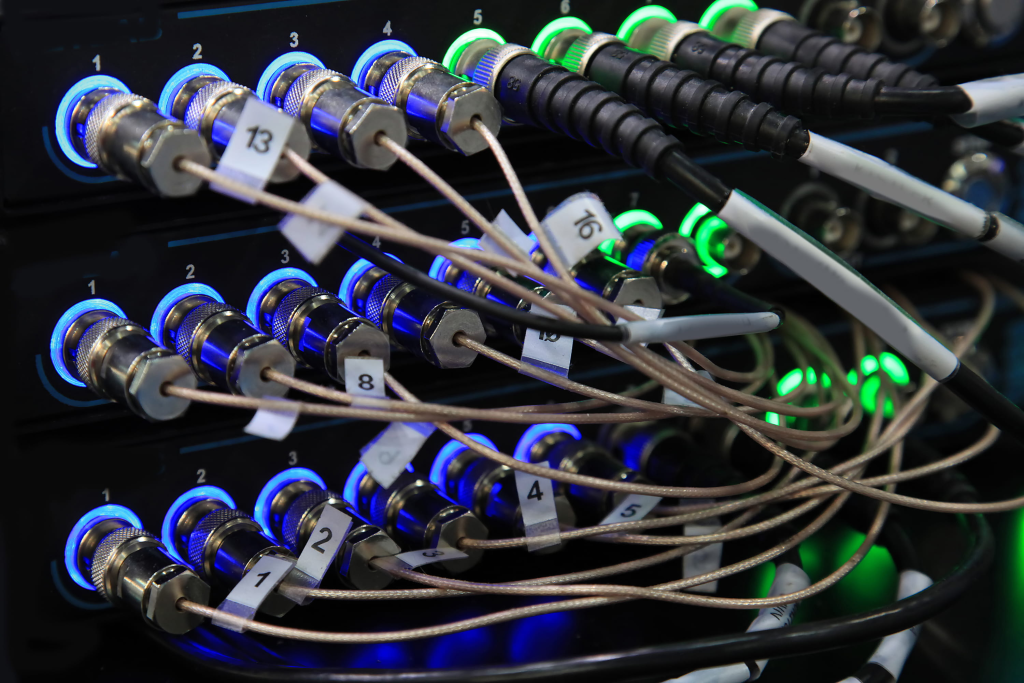
A fixed attenuator is a passive component that reduces optical power by a fixed, constant amount. Think of it as a permanent filter. Once it is installed in your link, the amount of signal reduction stays exactly the same. Because they are passive devices, they don’t require any external power source to do their job.
How They Work
These devices use a variety of methods, such as doped fibers or mismatched joints, to absorb or scatter a precise amount of light. This reduction is measured in decibels (dB). In most standard networks, you will find them in common pre-set increments:
- 1dB to 5dB: Used for minor “padding” to prevent slight over-saturation.
- 10dB: A standard choice for mid-range signal reduction.
- 15dB to 20dB: Often used in short-loop applications where a high-power long-haul laser is firing over a very short distance.
Best Use Cases
Fixed attenuators are the workhorses of permanent fiber installations. They are most commonly used in:
- Long-Haul Singlemode Links: When a high-output laser is used, but the physical distance of the fiber isn’t long enough to naturally drop the signal power.
- Data Centers: For stabilizing connections between switches and routers where the power levels are known and won’t change.
- SFP Protection: Providing a “set it and forget it” safety net for sensitive optical transceivers.
The Trade-Offs
Like any specialized tool, fixed attenuators have specific advantages and limitations:
- The Pros: They are incredibly reliable, compact, and cost-effective. Because they have no moving parts, there is very little that can go wrong over the network’s lifespan.
- The Cons: They lack flexibility. If your network architecture changes or your power levels fluctuate, a fixed attenuator cannot adapt. You would have to physically swap the part for one with a different dB rating.
What is a Variable Attenuator?
If a fixed attenuator is like a pair of standard sunglasses, a variable attenuator is more like a set of dimmable lights. These devices allow you to adjust the level of signal reduction on the fly, giving you precise control over the optical power reaching your receiver. Instead of being stuck with a single dB rating, you can “tune” the device to the exact level your specific environment requires.
Manual vs. Electronic Types
Variable attenuators generally fall into two categories based on how you adjust them:
- Manual Attenuators: These usually feature a screw or a dial. By physically turning the adjustment mechanism, you change the internal alignment or the amount of light-absorbing material in the path of the beam. They are popular for their simplicity and “hands-on” control.
- Electronic Attenuators: These are more advanced and can be controlled through software or a digital interface. They are often found in automated systems or remote sites where a technician cannot be physically present to turn a dial.
Best Use Cases
Variable attenuators are essential when flexibility is more important than a “set it and forget it” installation. They are frequently used in:
- Lab Testing and R&D: Engineers use them to simulate signal loss over various distances or to find the exact point where a receiver begins to fail.
- Troubleshooting: Technicians use them to test network margins or to temporarily balance a link while waiting for permanent components.
- Fluctuating Networks: In environments where power levels might shift due to different equipment configurations, a variable option allows for quick recalibration.
The Trade-Offs
While the versatility of a variable attenuator is a massive benefit, there are some factors to consider:
- The Pros: You get total control. A single variable attenuator can do the job of an entire kit of fixed attenuators, ranging from 0dB all the way up to 60dB in some cases. This makes them the ultimate tool for precision tuning.
- The Cons: They are more expensive than fixed versions and are physically larger. Because they have moving parts or electronic components, they are also more complex, which means they are generally reserved for testing or specific high-end applications rather than every link in a large-scale rollout.
Key Differences: A Side-by-Side Comparison
When deciding between these two options, the choice usually comes down to whether you need a permanent, stable fix or a flexible tool for a changing environment. Here is how they stack up across the three most important categories.
| Feature | Fixed Attenuator | Variable Attenuator (VOA) |
|---|---|---|
| Performance | High Stability. Provides an unchanging, set-and-forget signal reduction that is resistant to mechanical drift. | High Versatility. Allows for real-time "tuning" to find the perfect signal level for specific conditions. |
| Cost Efficiency | Budget Friendly. Low unit cost makes them ideal for large-scale permanent rollouts. | Premium Investment. Higher cost per unit, but one device can replace a whole kit of fixed values. |
| Form Factor | Plug-Style. Compact "build-out" units that plug directly into ports or in-line bulkheads. | In-line/Instrument. Often larger, featuring adjustment dials, screws, or digital interfaces. |
| Best For | Production networks, data centers, and long-haul links. | Lab testing, troubleshooting, and network R&D. |
Which is the Smarter Business Move?
For most production environments, fixed attenuators are the superior choice. They are cost-effective, take up less space in a patch panel, and eliminate the risk of a technician accidentally “re-tuning” a live link.
However, for testing and maintenance teams, a variable attenuator is an essential investment. It allows a technician to troubleshoot various power levels without carrying dozens of individual fixed parts, saving time and simplifying inventory in the field.
How to Choose: The Decision Matrix
Choosing the right attenuator doesn’t have to be a guessing game. Usually, the architecture of your project will dictate the best tool for the job. To help you decide, here are three common scenarios where one option clearly outperforms the other.
Scenario A: Building a Permanent Data Center Link
If you are installing a high-density fiber patch panel in a climate-controlled data center, you already know your distances and power budgets. Once the link is balanced, it shouldn’t need to be touched again for years.
- The Winner: Fixed Attenuator.
- Why: You want a small, reliable, and inexpensive solution that won’t be accidentally adjusted. A fixed “plug-style” attenuator stays out of the way and does its job indefinitely.
Scenario B: Field Testing and Troubleshooting ONT Devices
Imagine you are a technician visiting various customer sites to install or repair Optical Network Terminals (ONTs). Every house or office has a different length of fiber, meaning the light hitting your equipment will vary at every single stop.
- The Winner: Variable Attenuator.
- Why: Carrying a single variable attenuator is much easier than lugging around a bag full of different fixed values. It allows you to dial in the exact attenuation needed for that specific site to verify if the equipment is functioning correctly.
Scenario C: Protecting High-Sensitivity 10G SFP+ ZR Transceivers
ZR transceivers are designed for long distances (up to 80km). If you use them for a short-distance “loopback” test or a cross-connect in the same room, the laser will likely be strong enough to physically damage the receiving diode.
- The Winner: Fixed Attenuator.
- Why: This is about safety and consistency. Using a 10dB or 15dB fixed attenuator ensures that even if a cable is unplugged and moved, the protection remains part of the hardware chain. It provides a guaranteed “safety floor” for your most expensive optics.
Why Quality Matters: The Amerifiber Standard
In any fiber network, the smallest component can become the biggest point of failure. While an attenuator is technically designed to introduce “loss,” that loss must be extremely precise. Poorly manufactured attenuators can cause back-reflections (return loss) that bounce light back toward the source, potentially damaging expensive lasers or creating ghost signals that are impossible to troubleshoot.
The Singlemode Challenge
Quality is especially critical when dealing with single-mode fiber. Because single-mode is designed for high-power, long-distance transmission, the risk of receiver saturation is much higher than in multimode systems. If your attenuator isn’t precision-tested, it can lead to:
- Inconsistent Signal Reduction: A “5dB” attenuator that actually provides 3dB or 7dB can leave your network in the danger zone.
- Polarization Issues: Lower-quality components can interfere with the light’s path, leading to signal degradation over time.
- Mechanical Wear: Inferior housings can cause poor connections, leading to intermittent “flapping” links.
At Amerifiber, we specialize in the high-stakes world of single-mode connectivity. Every attenuator we provide is built to withstand the rigors of real-world deployment, ensuring that your dB levels stay exactly where you set them. Since 1986, we have built our reputation on the idea that “good enough” isn’t an option for critical infrastructure.
Ensure your network operates at peak performance. Don’t let a simple power imbalance compromise your uptime. Explore Amerifiber’s Singlemode Attenuator Collection for precision-engineered solutions that protect your hardware and your data.
Frequently Asked Questions
Can I use a variable attenuator for a permanent installation?
While you can do it, it’s generally not recommended for permanent production environments. Variable attenuators have moving parts or tuning screws that can drift over time due to vibrations or temperature changes. For a “set-and-forget” installation, a fixed attenuator is much more stable and cost-effective.
Do attenuators affect data speed?
No, an attenuator does not “slow down” the speed of light or change the frequency of your data. However, using the wrong level of attenuation can indirectly hurt your performance. If the signal is too strong or too weak, it creates bit errors, forcing the system to retransmit data packets. This retransmission is what causes the perceived drop in network speed.
What are the most common dB levels for fixed attenuators?
In most standard fiber networks, you will find fixed attenuators in increments of 1dB, 3dB, 5dB, 10dB, and 15dB. The 5dB and 10dB versions are the industry “standards” for most singlemode applications where a laser is just slightly too “hot” for the receiver.
Where should I place the attenuator in my link?
The best practice is to install the attenuator at the receiver end of the link. This allows you to measure the incoming power with a meter before it hits the receiver, and it also prevents unwanted back-reflections from traveling all the way back to the sensitive transmitter laser.
Do I need attenuators for multimode fiber?
It is very rare. Multimode transceivers typically use LED or VCSEL light sources that are rarely powerful enough to saturate a receiver. Attenuators are almost exclusively a requirement for singlemode systems, which use high-power lasers designed for much longer distances.