
Highlights
- Each Ethernet cable category impacts speed, shielding, and reliability.
- Higher categories deliver faster speeds, better EMI protection, and future-proof scalability.
- Using the wrong cable can lead to signal degradation, latency, and expensive replacements.
- Choosing the right cable ensures long-term network stability and cost-effective upgrades.
Why Cable Category Matters
The Ethernet cable category you select directly influences your network’s performance. Here’s how it impacts key factors:
- Speed and Bandwidth Capacity: Higher-category cables support faster data transfer rates and greater bandwidth, critical for modern applications.
- Distance Limitations: Advanced categories can maintain signal quality over longer distances, preventing performance degradation.
- Resistance to EMI (Electromagnetic Interference): Shielded and higher-grade cables offer better protection against interference, ensuring stable connections.
Using a low-grade cable in a high-performance environment can cause slowdowns, data loss, or even network failures. For mission-critical systems, choosing the right cable ensures long-term reliability and optimal performance.
Cat5 vs Cat6 vs Cat7 vs Cat8: A Detailed Comparison
Below is a side-by-side comparison to help identify which option best suits your needs:
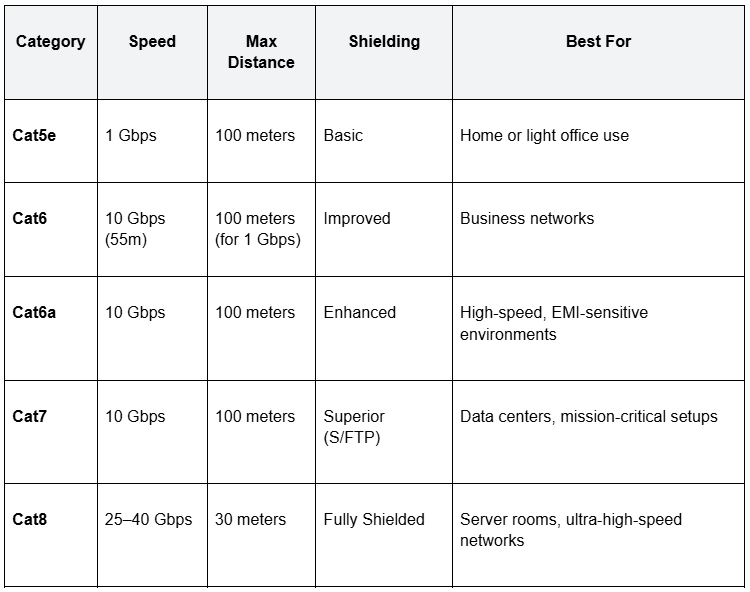
Selecting the right cable depends on your specific application. For home or small office networks, Cat5e or Cat6 is often sufficient. Businesses requiring high-speed connections or environments with high electromagnetic interference (EMI) might benefit from Cat6a. For mission-critical installations like data centers or server rooms, Cat7 and Cat8 offer the highest performance, ensuring ultra-fast data transfer and robust shielding.
Performance Factors to Consider
Before selecting a cable, evaluate these key elements:
Speed Requirements
Higher categories support greater speeds, up to 40 Gbps with Cat8. For applications requiring ultra-fast data transfer, choosing a high-performance cable is crucial.
Distance Constraints
Some high-speed cables, like Cat8, are designed for shorter distances, typically around 30 meters. If you require longer runs, consider lower category cables like Cat6 or Cat6a, which balance speed and distance effectively.
Recommended Reading: Ethernet Max Distance
EMI Sensitivity
For installations in environments with high electromagnetic interference (EMI), shielded cables such as Cat6a, Cat7, or Cat8 are essential. These cables protect data integrity and minimize signal disruption.
Scalability Needs
Future-proof your infrastructure by choosing cables that exceed current speed and performance requirements. This ensures smooth upgrades and compatibility with emerging technologies.
Recommended Use Cases by Cable Type
Recommendations based on typical applications:
Home or Light Office Use
Cat5e or Cat6 — These cables are perfect for everyday activities like browsing the web, streaming videos, or making VoIP calls. They offer reliable performance at an affordable price, making them a popular choice for home networks and small-scale office setups.
Small to Mid-Sized Businesses
Cat6 or Cat6a — Designed for more demanding environments, these cables provide the speed and reliability needed for tasks such as video conferencing, cloud-based applications, and internal file sharing. They are a great solution for growing businesses seeking enhanced network efficiency.
Enterprise & Industrial Environments
Cat7 or Cat8 — When unparalleled speed and durability are essential, Cat7 and Cat8 cables rise to the challenge. Ideal for data centers, server farms, and areas prone to electromagnetic interference (EMI), these cables ensure high-speed data transmission and network reliability even in the most demanding conditions.
Discover Your Ideal Network Solution with AmeriFiber
Your network deserves the best foundation, and AmeriFiber is here to help you achieve that. Our dedicated team is ready to guide you through the process, offering tailored support every step of the way.
Contact us today to explore how we can optimize your network with custom Ethernet cable solutions!
- Fill out our online form: Contact Us
- Call us directly at 866-518-5858
- Visit us at 200 Hembree Park Drive, Suite D, Roswell, GA 30076
Frequently Asked Questions
1. What’s the difference between Cat5 and Cat6?
Cat6 supports up to 10 Gbps over short runs and has better shielding than Cat5e, making it more reliable for modern networks.
2. Is Cat7 better than Cat6a?
Yes. For environments with high EMI, Cat7 offers superior shielding and consistent 10 Gbps performance.
3. When should I use Cat8?
Use Cat8 for ultra-fast, short-distance connections like those in data centers and server rooms, supporting up to 40 Gbps.
4. How do I future-proof my network?
Choose higher-category cables (Cat6a or above) and partner with Amerifiber for custom-built, high-performance solutions.